



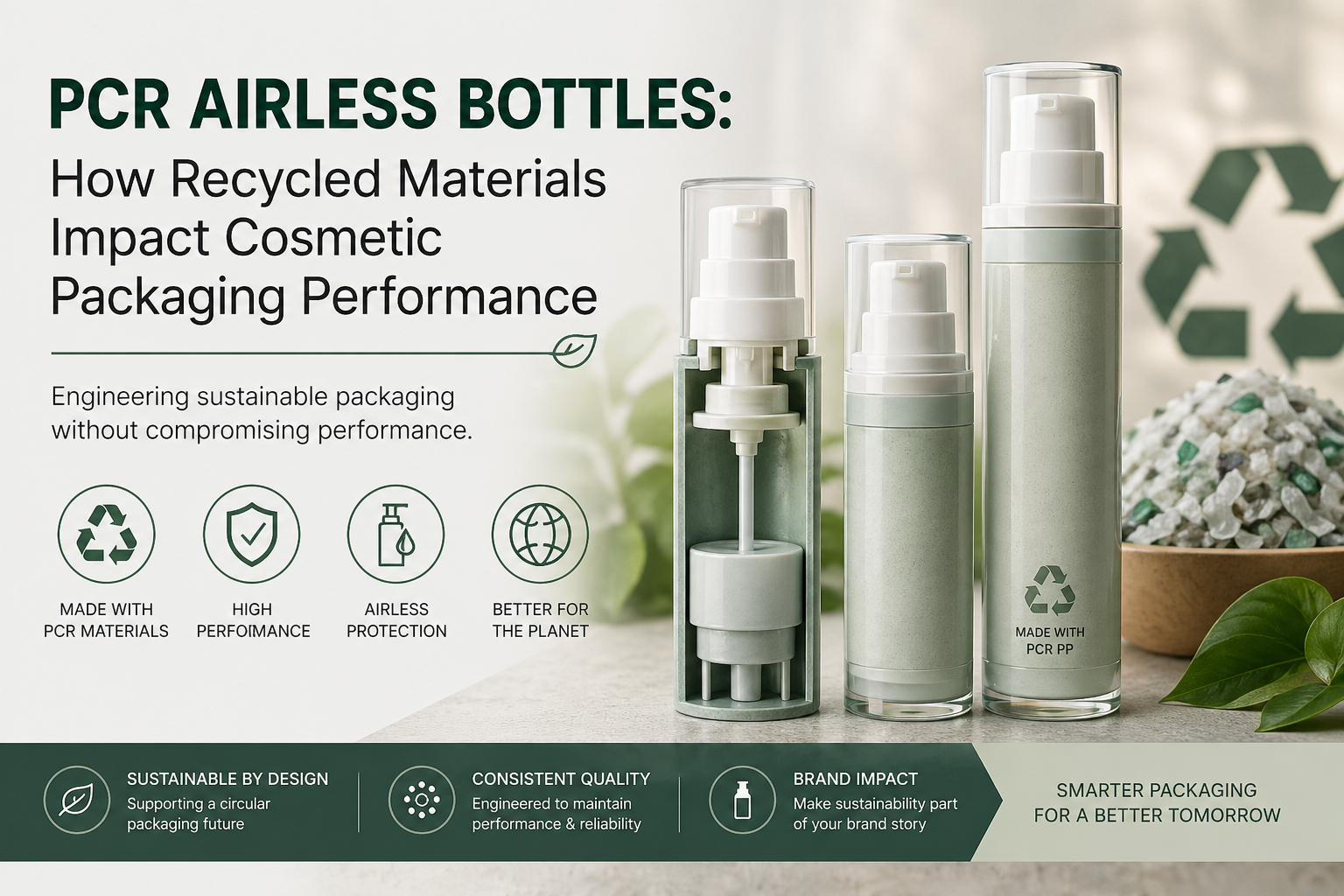
Introduction: When Recycled Packaging Starts Affecting Product Performance
A cosmetic brand switches to PCR packaging to meet retailer sustainability requirements. The expectation is simple: reduce environmental impact without changing product experience.
But after launch, issues start appearing—slightly inconsistent dispensing, variation in bottle color, and unexpected pump resistance.
The problem isn’t the concept of PCR. It’s the interaction between recycled material properties and precision-dependent airless systems.
For brands already using airless pump bottles for cosmetics, transitioning to PCR is not just a material swap—it’s a performance variable. This article breaks down how PCR materials directly influence airless bottle functionality, from structural integrity to dispensing consistency.
What Makes PCR Airless Bottles Technically Different?
PCR (Post-Consumer Recycled) airless bottles use plastic that has been collected, processed, and reintroduced into manufacturing—most commonly polypropylene (PP).
Unlike virgin resin, PCR material introduces controlled variability.
Key Technical Difference:
Virgin plastic is engineered for consistency. PCR plastic must be engineered around inconsistency.
This distinction is critical in airless systems, where:
- Airtight sealing
- Piston movement
- Pump responsiveness
all depend on precise tolerances.
Material Behavior: How PCR Changes Physical Properties
Recycled plastic behaves differently at a molecular and processing level.
1. Melt Flow Variability
PCR materials often have:
- Inconsistent melt flow index (MFI)
- Slight variations in viscosity during molding
👉 Impact:
- Affects how components are formed
- Can lead to dimensional inconsistencies
2. Reduced Mechanical Strength
Compared to virgin PP:
- PCR may have lower tensile strength
- Higher susceptibility to stress over time
👉 Impact:
- Requires structural reinforcement in bottle design
- Thicker walls in critical areas
3. Surface Finish Differences
PCR resin can produce:
- Slightly rougher internal surfaces
- Micro-variations in texture
👉 Impact:
- Influences piston friction
- Affects smooth dispensing performance
Airless System Sensitivity: Why Material Matters More Here
Airless bottles are more sensitive to material changes than standard packaging.
Why?
Because airless pump bottles for cosmetics rely on:
- Vacuum pressure
- Airtight sealing
- Controlled piston movement
Even minor material deviations can affect:
- Pump force
- Output consistency
- Product evacuation rate
Example:
A small increase in friction between piston and wall can:
- Increase actuation force
- Reduce user experience quality
Engineering Adjustments Required for PCR Integration
To maintain performance, manufacturers must adapt both design and production.
Design-Level Adjustments:
- Optimized piston geometry for smoother movement
- Reinforced neck and actuator zones
- Adjusted tolerance ranges to account for variability
Material Blending Strategy:
Most PCR airless bottles use:
- 30–50% PCR blended with virgin PP
👉 Why:
- Maintains structural stability
- Reduces performance risk
- Improves process consistency
Processing Controls:
- Advanced filtration to remove contaminants
- Controlled temperature profiles during molding
- Batch-level quality verification
Dispensing Performance: What Actually Changes
For cosmetic brands, the most noticeable impact is in user interaction.
Key Performance Areas:
1. Actuation Force
PCR may slightly increase resistance:
- Pump feels firmer
- Requires recalibration in design
2. Output Consistency
Variability can lead to:
- Slight differences in dosage per pump
- Less uniform dispensing over lifecycle
3. Product Evacuation Efficiency
Well-designed PCR airless systems still achieve:
- 90–98% evacuation rates
But only when:
- Piston sealing is optimized
- Internal surface friction is controlled
Compatibility With Cosmetic Formulations
PCR material can influence how formulations behave inside the bottle.
Suitable Formulations:
- Serums
- Creams with stable emulsions
- Standard skincare actives
Formulations Requiring Testing:
- High-viscosity creams
- Oil-heavy formulations
- Sensitive active ingredients
Key Testing Areas:
- Stability over time
- Interaction with recycled material
- Dispensing consistency across usage
Visual and Branding Considerations
PCR introduces aesthetic differences that brands must plan for.
Common Characteristics:
- Slight color variation between batches
- Grey or yellow undertones
- Reduced clarity
Solutions:
- Opaque finishes
- Matte textures
- Color masterbatch standardization
Strategic Insight:
Many brands now highlight these variations as:
Proof of recycled content rather than a defect
PCR vs Refillable Airless Bottles: Performance Perspective
While PCR focuses on material sustainability, refillable airless bottles address system reuse.
PCR Airless Bottles:
- Reduce reliance on virgin plastic
- Maintain single-use convenience
- Minimal behavior change for consumers
Refillable Airless Bottles:
- Extend packaging lifecycle
- Require user participation
- Introduce additional mechanical complexity
Performance Comparison:
- PCR = slight material-driven performance variation
- Refillable = mechanical durability considerations over repeated use
Quality Control: What Brands Should Validate
Before adopting PCR airless bottles, testing is essential.
Critical Validation Metrics:
- Actuation force consistency
- Air ingress (must remain zero)
- Pump cycle durability
- Dimensional stability
Supplier Questions to Ask:
- What PCR percentage is used?
- Is the material certified and traceable?
- What performance testing has been completed?
Use Case: Transitioning to PCR Without Compromising Performance
A skincare brand currently using standard airless pump bottles for cosmetics wants to improve sustainability.
Requirements:
- Maintain premium user experience
- Introduce recycled content
- Avoid production disruption
Solution:
- 40% PCR PP airless bottle
- Reinforced internal structure
- Matte opaque finish for consistency
Outcome:
- Stable pump performance
- Improved sustainability positioning
- No significant change in user experience
Where PCR Airless Packaging Is Heading
Advancements in material processing are improving PCR performance.
Key Developments:
- Higher PCR ratios with improved strength
- Better filtration and purification technologies
- Integration with mono-material designs
- Compatibility with refillable systems
Final Thoughts: PCR Changes Performance—But It Can Be Engineered
PCR airless bottles introduce variability, but that variability can be controlled through engineering, design, and testing.
For brands already using airless pump bottles for cosmetics, PCR is a logical next step—if performance considerations are addressed early.
For those exploring refillable airless bottles, PCR can complement broader sustainability strategies by reducing material impact at the source.
Exploring PCR Airless Bottles for Your Product Line?
If you’re evaluating PCR airless bottles alongside traditional airless systems or refillable options, the key is aligning material selection with performance requirements.
We support cosmetic brands with:
- PCR material optimization
- Engineering-reviewed specifications
- Pre-production sampling (PPS)
- Scalable manufacturing coordination
Contact US to explore how PCR airless packaging can be implemented without compromising product performance or brand quality.
Frequently Asked Questions About PCR Airless Bottles
What are PCR airless bottles?
PCR airless bottles are cosmetic packaging made with post-consumer recycled plastic while still using an airless dispensing system to help protect formulas from air exposure.
Do PCR airless bottles affect product performance?
PCR materials can affect color consistency, pump feel, and dispensing performance, but a well-engineered bottle can maintain reliable performance through proper material selection and testing.
Are PCR airless bottles suitable for skincare packaging?
Yes. PCR airless bottles are suitable for many skincare products, including serums, lotions, and creams, especially when the formula requires airless protection.
What percentage of PCR material is best for airless bottles?
Many brands start with 30%–50% PCR because it balances sustainability with packaging strength, appearance, and dispensing reliability.
How are PCR airless bottles different from refillable airless bottles?
PCR airless bottles reduce virgin plastic use, while refillable airless bottles reduce waste by extending the packaging lifecycle through reuse.