



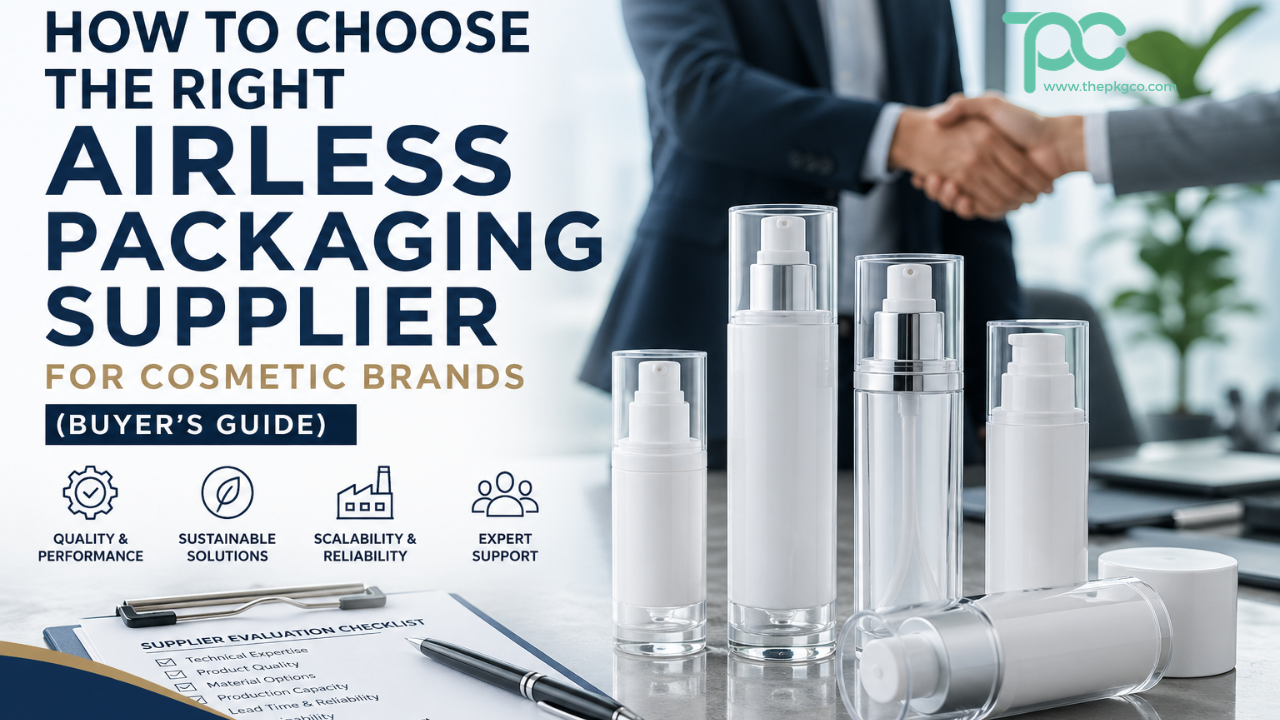
Introduction: A Supplier Decision That Directly Impacts Product Performance
Choosing the right airless packaging supplier is one of the most critical decisions for cosmetic brands preparing to scale a product line. The wrong supplier can lead to inconsistent dispensing, delayed production timelines, and packaging failures that directly impact customer experience.
This is especially important when working with airless pump bottles for cosmetic products, where performance depends on precision engineering rather than just container design.
This buyer’s guide breaks down exactly what to evaluate—from technical capability to scalability—so you can confidently select a supplier that supports both your product performance and long-term growth.
Quick Supplier Evaluation Checklist
Before selecting an airless packaging supplier, make sure they can meet these key requirements:
- Proven experience with airless pump systems
- Consistent product quality and performance testing
- Material options (standard, PCR, mono-material, refillable)
- Scalable production capacity
- Reliable lead times and communication
👉 If a supplier cannot clearly answer these areas, it’s a red flag.
Why Choosing the Right Airless Packaging Supplier Matters
Airless packaging is fundamentally different from standard cosmetic containers.
Unlike traditional bottles, airless pump bottles for cosmetic applications rely on:
- Vacuum-based dispensing systems
- Airtight internal structures
- Precise piston movement
Even small inconsistencies can affect:
- Pump performance
- Product dosage
- Shelf-life protection
👉 This makes supplier capability far more important than price alone.
Step 1: Evaluate Technical Expertise, Not Just Product Catalog
Not all suppliers who offer airless packaging understand how airless pump systems actually work.
What to Look For:
- Engineering support (not just sales support)
- Understanding of formulation compatibility
- Experience with skincare and active ingredients
Key Questions:
- Can they recommend the correct airless pump output based on viscosity?
- Do they provide technical drawings and specifications?
- Have they worked with serums, creams, or active formulations?
Step 2: Assess Product Quality and Consistency
Airless systems require tight tolerances to function properly.
Key Performance Factors:
- Pump durability (cycle testing)
- Consistent output per stroke
- Airtight sealing
What to Request:
- Pre-production samples (PPS)
- Pump lifecycle testing data
- Leak and air ingress test results
Step 3: Understand Material Options and Capabilities
A strong supplier should offer flexible material solutions aligned with your brand strategy.
Common Options:
- Standard PP or PET airless bottles
- PCR airless bottles for sustainability
- Mono-material airless systems for recyclability
- Glass airless packaging for premium positioning
👉 Different materials require different technical expertise—your supplier must understand all of them.
Step 4: Evaluate Customization and Branding Support
Packaging plays a major role in brand perception.
Look For:
- Custom color matching
- Decoration options (printing, coating, metallization)
- Mold development for unique designs
Important:
Some suppliers only offer stock packaging, while others support full customization.
Step 5: Check Production Capacity and Scalability
A supplier that works for small batches may not support long-term growth.
Ask:
- What is the monthly production capacity?
- Can they scale with your brand?
- Do they have backup production capabilities?
Step 6: Review Lead Time and Supply Reliability
Packaging delays can delay your entire product launch.
Evaluate:
- Production lead time
- Raw material sourcing stability
- Ability to handle urgent or large orders
Step 7: Verify Quality Control and Certifications
For cosmetic packaging, compliance is non-negotiable.
Look For:
- ISO certifications
- Cosmetic-grade material compliance
- Internal quality control systems
Step 8: Compare Cost Beyond Unit Price
The lowest price is not always the best choice.
Consider Total Cost:
- Defect rate
- Product returns
- Logistics and shipping
- Supplier reliability over time
Step 9: Evaluate Sustainability Capabilities
Sustainability is now a key decision factor for cosmetic brands.
Ask:
- Do they offer PCR airless bottles?
- Can they support refillable airless bottles?
- Do they provide mono-material packaging solutions?
👉 Your supplier should support both current needs and future sustainability goals.
Step 10: Assess Communication and Long-Term Support
Strong communication is essential for a reliable partnership.
Indicators of a Good Supplier:
- Fast response time
- Clear communication
- Problem-solving mindset
Common Mistakes Cosmetic Brands Make
- Choosing based on price alone
- Skipping product testing
- Ignoring scalability
- Overlooking pump performance
How This Connects to Your Airless Packaging Strategy
Choosing the right supplier directly impacts your ability to implement:
- airless pump bottles for cosmetic products
- Sustainable packaging solutions (PCR, mono-material)
- Refillable systems for long-term growth
👉 A capable supplier supports all of these—not just one.
Final Thoughts: Choose a Supplier That Scales With You
Airless packaging is not just a component—it’s part of your product performance and brand experience.
The right supplier ensures:
- Consistent quality
- Reliable production
- Alignment with your brand strategy
Looking for a Reliable Airless Packaging Supplier?
We support cosmetic brands with:
- Engineering-reviewed specifications
- Material consultation (PCR, mono-material, refillable)
- Pre-production sampling (PPS)
- Scalable manufacturing coordination
Reach out to explore how we can support your packaging needs.
Frequently Asked Questions About Airless Packaging Suppliers
What should cosmetic brands look for in an airless packaging supplier?
Brands should evaluate technical expertise, product quality, material options, production capacity, and the supplier’s ability to support long-term growth.
Why is supplier experience important for airless packaging?
Airless packaging relies on precise engineering. Experienced suppliers are more likely to deliver consistent pump performance and reliable product quality.
How do I test an airless packaging supplier?
Request pre-production samples, test pump performance, and review dispensing consistency before placing bulk orders.
Do all suppliers offer sustainable airless packaging options?
No. Brands should verify if suppliers offer PCR, mono-material, or refillable airless packaging solutions.
What is the biggest mistake when choosing a supplier?
The most common mistake is choosing based on price alone without evaluating quality, performance, and long-term reliability.