



Child-resistant packaging is required across every regulated cannabis market in the United States and across a growing range of pharmaceutical, nutraceutical, and wellness product categories. For brands navigating these markets, CR packaging is a system of decisions involving format selection, certification documentation, supplier qualification, and ongoing compliance management that has to work reliably across every production run and every state where the product is sold.
This guide covers what child-resistant packaging is, how certification works, which formats are available, how to choose between them, and what compliance management looks like in practice.
What Child-Resistant Packaging Is and Why It Exists
Child-resistant packaging is any container specifically engineered and tested to significantly delay or prevent access by young children, while remaining functional for adults. The legal framework comes from the federal Poison Prevention Packaging Act (PPPA) of 1970, which gave the Consumer Product Safety Commission authority to require CR packaging for household substances posing a risk of serious harm to children.
The term “child resistant” is legally precise. It means the package passed standardized third-party panel tests demonstrating significant resistance to opening by children under five. It does not mean no child can ever open the package. “Child proof” is not a legal standard and does not exist in federal regulation. Brands using “child proof” language on packaging or in marketing materials should update to “child resistant” to reflect the accurate certification status.
The Federal Certification Standard
The primary standard governing CR packaging in the United States is 16 CFR §1700.20, the Consumer Product Safety Commission regulation under the federal PPPA. It applies to both reclosable and non-reclosable packaging and is the standard referenced by name in most state cannabis regulations. This is the standard that matters most for cannabis, wellness, and regulated product brands.
Testing under 16 CFR §1700.20 is conducted by an accredited independent laboratory using human subject panels.
The child panel uses children ages 42–51 months. At least 85% must fail to open the package within a 10-minute window.
The adult panel uses participants ages 50–70. At least 90% must successfully open and close the package within 5 minutes.
Both panels must pass. A package that children cannot open but that adults also cannot reliably close fails certification.
Some formats are also tested to ASTM methods (F1272 for reclosable tins and jars, F1702 for tubes and squeeze tubes) as a supporting test methodology. Where ASTM is cited alongside 16 CFR §1700.20, it reflects the testing method used to verify compliance with the CFR standard, not a separate or equivalent certification. When evaluating supplier documentation, confirm the product is certified to 16 CFR §1700.20 specifically, not to ASTM alone.
Who Needs Child-Resistant Packaging
Cannabis Brands
Every licensed US cannabis state requires CR packaging at the point of consumer sale. The requirement covers all product categories: flower, pre-rolls, edibles, concentrates, vapes, and topicals. Specific state requirements vary, but the mandate is universal across regulated markets.
Compliance failure creates regulatory exposure that sits with the brand, not the supplier. Pulled product, operational holds, and license review are the real consequences. CR packaging documentation is an ongoing operational responsibility, not a one-time sourcing decision.
Pharmaceutical and OTC Products
Federal law under the PPPA requires CR packaging for most prescription drugs and many over-the-counter medications. Iron-containing supplements with 250mg or more of elemental iron per unit carry a specific federal CR requirement. Certain household chemicals above specified concentration thresholds also require CR packaging.
CBD and Hemp-Derived Products
CBD products sold through licensed cannabis retail channels are subject to the same CR requirements as cannabis products in most regulated states. Hemp products sold outside licensed cannabis channels have more variable requirements. Confirm state-specific requirements for each market before distributing.
Wellness and Nutraceutical Brands
Supplement and wellness brands entering pharmacy distribution or licensed retail channels frequently encounter CR requirements, either as a regulatory mandate or as a channel prerequisite from the retail buyer. Brands building packaging programs for multi-channel distribution benefit from specifying CR-certified formats from the outset.
Child-Resistant Packaging Formats
CR packaging spans a wide range of container types. The right format is determined by the product’s physical requirements, the brand’s retail positioning, and the certification standard required by the target market.
CR Tins
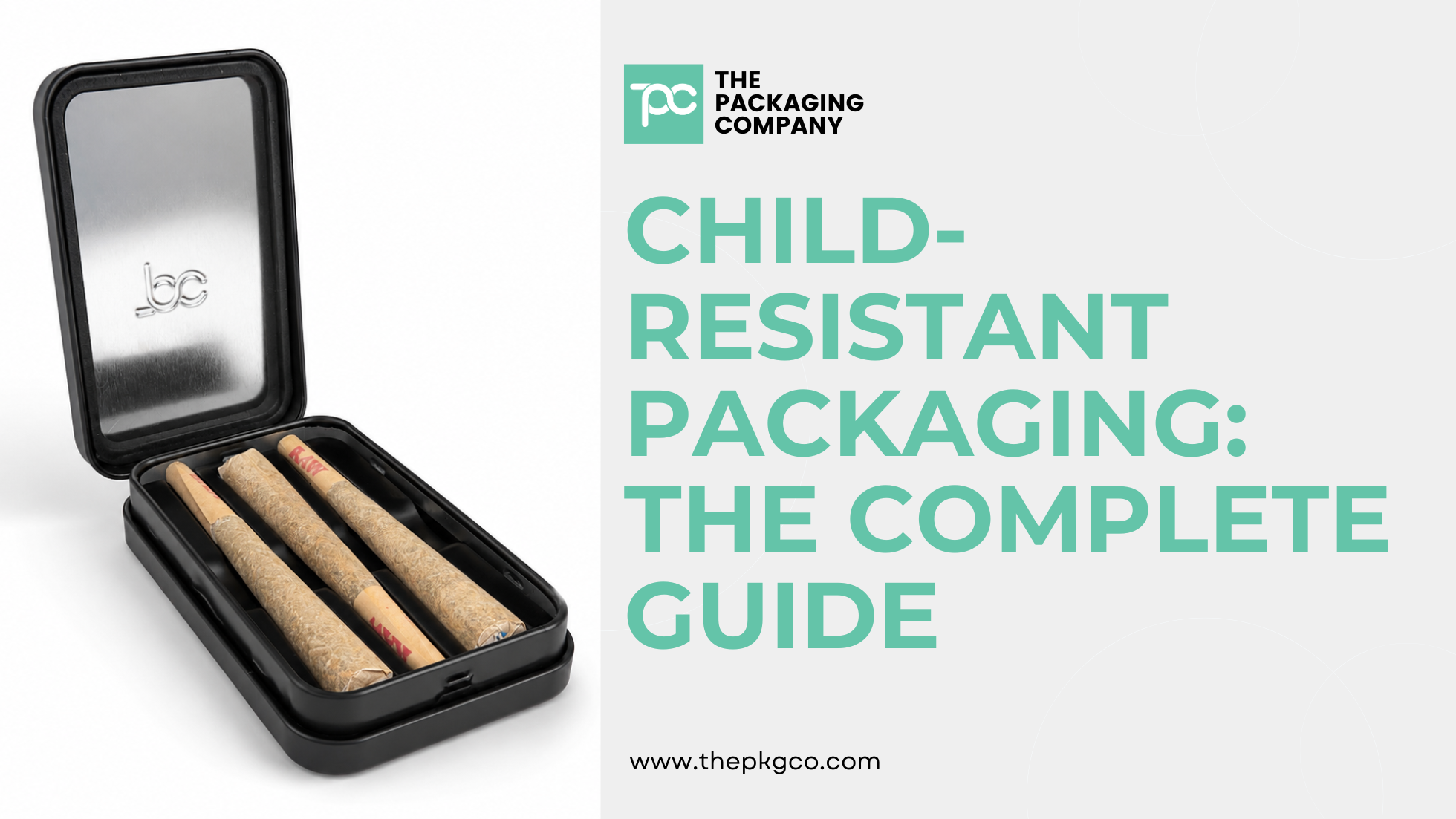
Metal tins with engineered closure mechanisms are the premium standard for cannabis pre-roll and flower brands. TPC’s tin line includes snap tins (V5 and V5E) with a corner-press closure, and hinge-lid tins (V1, V1A, V4A, V7) with squeeze-to-open mechanisms. All are certified to 16 CFR §1700.20.
Metal tins deliver the strongest brand signal of any CR format at the shelf. Weight, closure feel, and rigid construction communicate quality before a consumer reads anything. The tin body on all-metal formats is fully recyclable. Note that assembled tin products may include insert trays, gasket seals, or other components in different materials. Recyclability claims should be scoped to the specific component they apply to.
CR Tubes (Pre-Roll)
CR tubes for pre-rolls include glass and aluminum formats. Glass tubes are available in Short Cap, Standard Cap, and Aluminum Overshell Cap variants. Note on the Aluminum Overshell Cap: the CR mechanism is plastic; the aluminum is a decorative overshell fitted over it. Aluminum pre-roll tubes are available as single-unit and multi-pack formats.
CR tubes are the most widely used pre-roll packaging format in the industry. Tube diameter and length must be matched precisely to the product. A tube that does not engage its CR closure correctly is a compliance failure regardless of the tube’s certification status.
CR Topical Packaging
CR topical packaging covers a wide range of formats for cannabis topicals, CBD products, and regulated wellness formulations: airless pump bottles, squeeze tubes, roll-on bottles, dropper bottles, cream jars, and lip balm tubes. This is a distinct category from pre-roll tubes. Lotion tubes, squeeze tubes, and topical tubes live here, not in the CR Tubes category.
The Child-Resistant Glass Cream Jar and Child-Resistant Plastic Cream Jar are positioned for creams and topicals only. They are not suited for flower, edibles, or concentrates, which have their own dedicated CR jar line.
CR Jars
CR jars cover cannabis flower, concentrates, and edibles requiring wide-mouth access. Available in glass, plastic, aluminum, and tin with push-and-turn or squeeze-and-turn lids. Glass CR jars are the standard for concentrate and premium flower applications: completely inert, with UV blocking in tinted glass variants.
CR Mylar Bags
CR mylar bags are the cost-efficient flexible format for bulk flower, edibles, and value-tier SKUs. Available from 1g through 28g with full custom printing in matte, gloss, metallic, and specialty finishes. The CR slide-lock closure must be evaluated over repeated use cycles. A closure that degrades with repeated opening will not maintain certified performance through the product’s consumer lifecycle.
How to Choose the Right CR Format
Four filters applied in sequence narrow the viable format options for any specific product.
Filter 1: Product dimensions and functional requirements. Pre-roll length, diameter, and count determine which tin or tube formats are viable. Fill weight determines jar and bag size. Formulation viscosity and barrier requirements determine topical format construction. Formats that cannot accommodate the product physically are eliminated before any other variable is considered.
Filter 2: Certification standard required. Confirm whether your state requires 16 CFR §1700.20 for your product category. Confirm that the specific format carries that certification with third-party test documentation available. This filter eliminates formats that carry the wrong certification regardless of how well they fit the product.
Filter 3: Brand positioning and price point. The format must match the product’s retail price signal. A $35 infused pre-roll in a mylar bag creates a disconnect that works against the brand at the shelf. A $10 value-tier pre-roll in a premium embossed tin is misaligned in the other direction. Format communicates price tier before a word is read.
Filter 4: MOQ and production timeline. The right format for filters 1–3 still has to work within the brand’s opening order quantity and launch timeline. MOQ varies by format at TPC: most tins and aluminum pre-roll tubes start at 5,000 units; squeeze tubes, glass tubes, jars, and dropper bottles typically start at 10,000 units. Lead times range from 4–6 weeks for standard jars and tubes to 8–12 weeks for full lithographic tin decoration. If the launch date is fixed, work backwards from it.
CR Packaging Documentation: The Compliance System
Documentation management is where most CR packaging compliance programs break down — not at the initial sourcing decision, but in the months and years of production that follow.
The documents that matter:
Third-party laboratory test report. The primary certification document. Names the accredited testing lab, the specific format and closure mechanism tested, the applicable standard (16 CFR §1700.20), and the pass rates for both the child panel and adult panel. This is what state compliance inspectors ask for. A Certificate of Compliance without an underlying test report is an assertion, not evidence.
Certificate of Compliance (CoC). A supplier-generated summary of the test report. Useful for day-to-day reference but not a substitute for the test report in a compliance inspection.
Reorder confirmation. Written confirmation from the supplier at each reorder that the current production run matches the tested and certified specification. This is the document that maintains certification currency across multiple production runs.
Packaging compliance register. A brand-side document mapping every active CR packaging SKU to its certification documentation, reorder confirmation chain, and file location. When a compliance inspector asks for documentation, the response should take under an hour.
For a detailed breakdown of how to build and maintain this system, see our CR packaging audit-readiness guide.
Working With TPC on Child-Resistant Packaging
TPC has served cannabis, pharmaceutical-adjacent, and regulated wellness brands since 1994, over 30 years across industries. Our founder established wholly-owned operations in China in the 1990s, which means our China team manages production oversight directly, providing the documentation traceability from the certified format through the specific production run that regulated-market brands need to demonstrate compliance.
Our CR packaging line spans tins, tubes, jars, bags, and topical formats, all with full certification documentation, made-to-order production, and pre-production samples standard before any bulk commitment. MOQ starts at 5,000 units and varies by format.
For a deeper look at how to evaluate any CR packaging supplier before placing a bulk order, see our 10 questions guide. To start a conversation about your specific product and compliance requirements, contact our team.
Frequently Asked Questions
What is child-resistant packaging? Child-resistant packaging is any container that has passed third-party panel testing confirming that at least 85% of children ages 42–51 months cannot open it within 10 minutes, and that at least 90% of adults ages 50–70 can open and close it within 5 minutes. The primary federal standard is 16 CFR §1700.20. Certification is a status earned through formal independent testing, not a design description or marketing claim.
Is child-resistant packaging required for cannabis products? Yes, in every licensed US cannabis state. CR packaging is required at the point of consumer sale for all cannabis product categories. The specific certification standard required varies by state, but the mandate is universal across regulated markets.
What is the difference between child resistant and child proof packaging? Child resistant is the legally defined standard under federal law. It means the packaging passed panel testing demonstrating significant resistance to opening by young children. Child proof is not a legal standard. Use “child resistant” for accurate compliance terminology.
How do I know if my CR packaging certification is valid? Request the third-party laboratory test report from your supplier. Confirm it names an accredited testing lab, covers the specific format and closure mechanism you are ordering, states 16 CFR §1700.20 as the applicable standard, and documents pass rates for both panels. At each reorder, request written confirmation that the current production run matches the tested specification.
What CR packaging format is most cost-efficient for high-volume cannabis products? CR mylar bags are the most cost-efficient format for high-volume cannabis products, available from 1g through 28g with full custom printing at a lower per-unit cost than rigid formats. For value-tier flower, edibles, and bulk pre-roll formats where per-unit packaging cost is the primary driver, bags are the standard choice.
What CR packaging format communicates premium most effectively? CR metal tins deliver the strongest premium signal of any CR format. Weight, closure feel, and rigid construction communicate quality before a consumer reads anything. Tins also carry the longest post-use brand life of any CR format since consumers keep and reuse them, extending brand presence beyond the product lifecycle.
Does child-resistant packaging affect recyclability? It depends on the format and the specific components. Metal tin bodies are recyclable; assembled tin products may include plastic insert trays, gasket seals, or other components that are separate materials. Glass jar bodies are recyclable; plastic caps are a separate component. Recyclability claims should always be scoped to the specific component they apply to, not to the assembled product as a whole. Metal formats offer the most straightforward recyclability story for the primary container.