



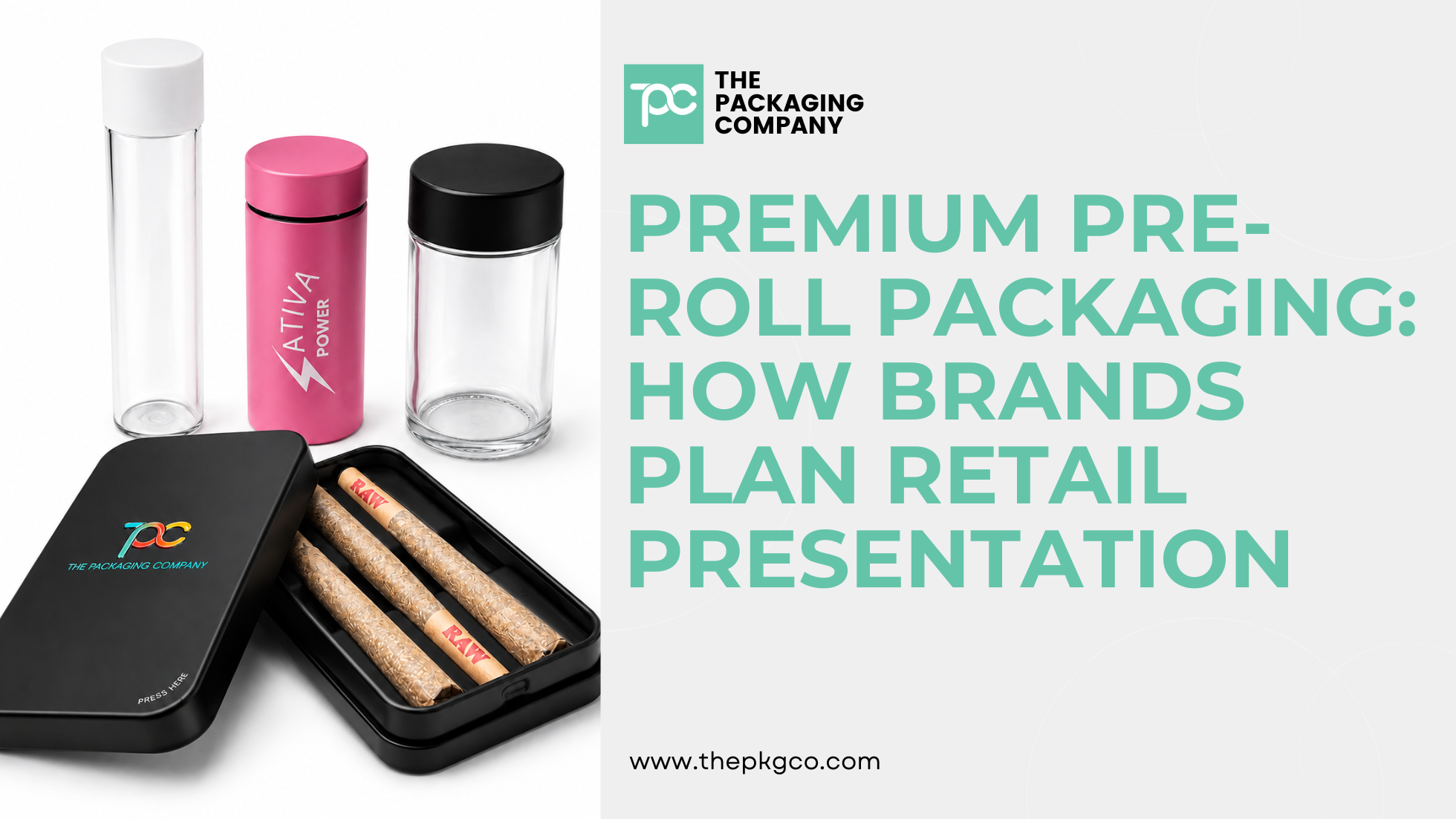
Premium pre-roll packaging is a series of decisions that build on each other. The format choice determines the label surface available. The label surface available shapes how the brand story gets told. How the brand story gets told affects retail sell-through. And sell-through determines whether the packaging investment earns back.
Brands that plan these decisions in sequence — format first, then label space, then retail presentation, then reorder consistency — build packaging programs that hold up. This guide covers that sequence for premium pre-roll packaging across tins and jars.
Format: Tins vs. Jars for Premium Pre-Rolls
The format decision is the most load-bearing one. Everything downstream — label space, retail presentation, product protection, and the brand signal at the shelf — is shaped by whether the pre-roll goes into a tin or a jar.
When Tins Are the Right Call
CR tins are the dominant premium pre-roll format for multi-pack programs: 3-packs, 5-packs, 7-packs, and configurations up to 14 pre-rolls in a double-stacked arrangement. Metal construction delivers the sensory premium that defines the format at shelf. Weight, closure feel, rigid structure. A well-decorated tin communicates quality before a consumer reads a word.
Tins work best when:
- The count configuration is 3 or more units presented as an organized multi-pack
- The retail price point is $20 or above and the packaging needs to support that signal visually and tactilely
- The brand has a strong graphic identity that benefits from the large flat decoration surface a tin lid provides
- Post-use brand presence matters, since consumers keep and reuse tins after the product is gone
TPC’s tin line covers a range of configurations, all certified to 16 CFR §1700.20:
The Child-Resistant Snap Tin (V5) at 74×58×20mm handles standard pre-roll lengths in 1–5 pack configurations.
The Child-Resistant Snap Tin, Extended (V5E) at 95×57×20mm accommodates 100mm king-size pre-rolls and larger multi-packs.
The Pre-Roll Tin Case (V1) at 102×98×14mm is the large-format flagship — ultra-slim 14mm profile, wide flat cavity for 5–7 pre-rolls, maximum lid surface for decoration.
The All-Metal Pre-Roll Tin (V1A) at 103×98×17mm provides a deeper cavity than the V1 in a fully recyclable all-metal construction. Note: the tin body is fully recyclable; the integrated gasket seal is a separate component.
The Dual-Button Pre-Roll Tin Box (V4A) at 101×63×15mm is a slim 3–5 pack format with a compact footprint suited to pocket-friendly retail display.
The Pre-Roll and Edible Tin Case (V7) at 102×97×27mm is the highest-capacity format in the line, accommodating up to 14 pre-rolls in a double-stacked configuration or large edible and capsule arrangements.
Each format carries its own insert tray configuration. Matching the tin to the pre-roll dimensions — length, diameter, and count — is the dimensional step that has to happen before label design, insert tray spec, or anything else.
When Jars Are the Right Call
CR glass jars are the premium format for single pre-rolls and infused formats where product presentation at opening is part of the brand experience. A glass jar holds pre-rolls upright in a vertical orientation, allowing the consumer to see the product before touching it. For live resin, rosin-infused, and high-terpene formats where the product’s visual quality is a marketing point, this display orientation communicates something a tin’s horizontal layout cannot.
Glass is completely inert. No material interaction with terpenes or cannabinoids, no off-gassing. For infused pre-rolls where terpene expression is a primary quality claim, glass is the packaging material that can honestly support it.
Jars work best for single-serve or small-count products (1–3 units), infused formats at a price point requiring visual quality communication, and brands positioned in the premium or luxury segment where glass reads as appropriate.
Label Space Planning: The Step Most Brands Skip
Label space planning means mapping required content to the available surface before design begins. Skipping it is the most consistent source of expensive late-stage revisions in pre-roll packaging programs.
What Label Space Has to Carry
Premium pre-roll packaging in regulated cannabis markets must carry significant mandatory content regardless of format. Required elements vary by state but typically include:
- THC content per unit and total THC per package
- Serving size and servings per container (infused formats)
- State-mandated warning language, often multi-line
- Universal symbol
- Producer name and license number
- Track-and-trace identifier or QR code
- Net weight or unit count
- Manufacture date and best-by date
- Child-resistant use instruction
This content adds up quickly. For a 5-pack tin with a 74×58mm lid, mandatory compliance content may consume 40–60% of the available print area before any brand design elements are placed.
The practice: before briefing a designer, create a content inventory — every mandatory element required in each distribution state. Lay that content out at actual size against the tin lid dimensions or the jar label area. The remaining space is the brand’s canvas. Brief the designer on that canvas, not the full surface. Brands that add compliance content after design is complete consistently run into legibility problems, overcrowded layouts, or non-compliant label designs requiring revision after approval.
Label Space on Tins vs. Jars
Tin lids offer a large flat rectangular surface. The V1’s 102×98mm lid is the largest canvas in TPC’s tin line. The V4A’s 101×63mm lid is more constrained but still fully printable. The snap tins at 74×58mm and 95×57mm support strong graphic design at that scale. Tin side panels provide additional surface for compliance content that overflows the lid, freeing the lid for primary brand design.
Glass jar labels wrap around a cylindrical surface. The usable height is the space between the shoulder and base. The seam where the label meets itself must be accounted for in the design. A physical mockup before production approval is essential, since flat design layouts often read differently when wrapped around a cylinder.
Retail Presentation: What the Dispensary Display Looks Like
Retail presentation planning means thinking about how the packaging performs at the point of sale — in the display case, on the shelf, and in the budtender’s hand during a recommendation.
Display Case Performance
Most premium pre-roll formats are displayed in a dispensary display case — behind glass, lit by high-CRI LED lighting, arranged by category or brand. The tin or jar needs to present well on all visible surfaces, because different angles are visible depending on the case configuration.
For tins displayed flat: the lid is the primary display surface. The lid design needs to read clearly from above or from the front depending on case orientation. Test the design at actual size from both orientations before approving.
For tins displayed on edge: the long side panel becomes the primary display surface. The brand name and key design elements need to be present on the side panel, not only on the lid.
For glass jars displayed upright: the label wrap and the visual of the product inside are both visible simultaneously. The product quality communicates through the packaging in real time — which is the format’s strength, but also means the product itself needs to present well upright.
The Budtender Hand-Off Moment
When a budtender hands a product to a customer for consideration, the package is held and inspected at close range for 10–30 seconds. This is the evaluation moment where tactile signals do as much brand work as the design.
A tin with a satisfying closure, a decoration surface that reads premium under hand-held inspection, and an insert tray that presents the product cleanly when opened does active selling work in that 30 seconds. For premium pre-roll brands, this moment should be treated as a designed touchpoint. Sample the filled, decorated, fully assembled package and evaluate it in that window before approving production.
MOQ and Reorder Consistency for Premium Tin Programs
Premium pre-roll tin programs have specific MOQ and reorder dynamics worth planning around before the first production commitment.
MOQ at TPC varies by format. Snap tins (V5 and V5E) start at 5,000 units. The Dual-Button Tin Box (V4A) and Pre-Roll and Edible Tin Case (V7) also start at 5,000 units. The large-format Pre-Roll Tin Case (V1) and All-Metal Pre-Roll Tin (V1A) start at 10,000 units. MOQ varies by format — confirm the requirement for your specific configuration during the quoting process.
For new SKU launches, starting at the MOQ floor is the right approach. It validates demand before committing to larger inventory. For established SKUs with known velocity, scaling the reorder quantity reduces reorder frequency and the lead time exposure associated with each new production run.
Decoration consistency across reorders for tins is managed through a physical color proof approval step before each full production run. This is the checkpoint that catches any print drift before it becomes a full run of off-color tins. For multi-SKU tin programs sharing brand color standards, specifying Pantone references across all SKUs and requiring color confirmation at each reorder keeps the presentation consistent across the line.
Insert tray reorders warrant attention when the pre-roll product changes. The insert tray is engineered to specific pre-roll dimensions. When format, diameter, or count configuration changes, the insert tray needs to be re-engineered. Initiate that process alongside the pre-roll product change.
Lead time for premium tin reorders with full lithographic decoration runs 8–12 weeks from order to delivery. For brands running high-velocity SKUs, maintaining 12–14 weeks of forward inventory before triggering a reorder protects against supply gaps that interrupt retail distribution.
Documentation at each reorder confirms that the current production run matches the 16 CFR §1700.20-certified format on file. For a full breakdown of how to structure and maintain CR documentation across reorders, see our CR packaging audit-readiness guide.
TPC’s Premium Pre-Roll Tin Line
All TPC CR tins are certified to 16 CFR §1700.20. All are made to order with full custom decoration and custom-engineered insert trays per project. Pre-production samples are standard before any production commitment.
Child-Resistant Snap Tin (V5) — 74×58×20mm, standard pre-rolls, 1–5 packs. MOQ 5,000 units.
Child-Resistant Snap Tin, Extended (V5E) — 95×57×20mm, 100mm king-size and larger multi-packs. MOQ 5,000 units.
Pre-Roll Tin Case (V1) — 102×98×14mm, 5–7 packs, ultra-slim profile, maximum lid surface. MOQ 10,000 units.
All-Metal Pre-Roll Tin (V1A) — 103×98×17mm, all-metal fully recyclable construction, deeper cavity. MOQ 10,000 units.
Dual-Button Pre-Roll Tin Box (V4A) — 101×63×15mm, slim 3–5 pack, pocket-friendly footprint. MOQ 5,000 units.
Pre-Roll and Edible Tin Case (V7) — 102×97×27mm, up to 14 pre-rolls double-stacked, highest capacity in the line. MOQ 5,000 units.
For the full pre-roll packaging format overview including tubes and glass jars, see our pre-roll packaging guide. For the complete CR packaging landscape, see our child-resistant packaging solutions guide. To start a conversation about your specific pre-roll format and retail requirements, contact our team.
Frequently Asked Questions
What is the best pre-roll packaging format for a premium price point? For multi-pack formats at $20 and above retail, CR tins are the format that most reliably supports the price signal. The weight, closure feel, and decoration surface communicate quality at the shelf before a consumer reads the label. For single-serve infused pre-rolls at high price points, CR glass jars provide visual product presentation that tins cannot. The format should match the product type, count configuration, and retail price point.
How do I plan label space for a CR tin pre-roll package? Start with a content inventory of every mandatory compliance element required in your distribution states. Map that content to the actual tin lid dimensions at real size. The remaining space is the brand design canvas. Brief the designer on the available canvas rather than the full surface. This prevents overcrowded layouts and post-approval revisions from adding compliance content after brand design is complete.
Can I use different tin sizes for different SKUs under the same brand? Yes, and this is common for tiered product lines. The brand design system needs to work across different tin dimensions. Consistent Pantone color specifications across all formats, confirmed at each reorder, maintains visual consistency across the line.
What MOQ applies to premium CR tins at TPC? MOQ varies by format: 5,000 units for the snap tins (V5, V5E), Dual-Button Tin Box (V4A), and Pre-Roll and Edible Tin Case (V7). The large-format Pre-Roll Tin Case (V1) and All-Metal Pre-Roll Tin (V1A) start at 10,000 units. All formats are made to order with no catalog inventory.
How far in advance do I need to reorder premium CR tins? Plan reorders when 12–14 weeks of forward inventory remain. Lead time for full lithographic decoration on CR tins runs 8–12 weeks from order to delivery. Waiting until inventory is critically low creates supply gaps that interrupt retail distribution, particularly for brands with active dispensary placements.
Do CR tins require a specific insert tray for my pre-roll format? Yes. Insert trays for TPC’s CR tins are custom-engineered to your exact pre-roll diameter, length, and count configuration. If your pre-roll format changes between orders, the insert tray needs to be re-engineered for the new configuration. Initiate that process alongside the pre-roll product change rather than after it.