


CBD packaging is one of the most variable categories in regulated product packaging. The requirements change based on how the product is classified, which channel it’s sold through, which state it’s distributed in, and whether it’s positioned as a wellness product, a hemp extract, or something adjacent to pharmaceutical use. That variability makes the packaging decision more complex than it is for a cannabis brand selling through a licensed dispensary, where the rules, while strict, are at least consistent within the state.
This guide is specifically for hemp-derived CBD brands and regulated wellness brands navigating CR packaging decisions across retail, pharmacy, e-commerce, and licensed cannabis channel distribution.
When CR Packaging Is Required for CBD Products
There is no single federal mandate that uniformly requires CR packaging for all CBD products. What exists is a patchwork of requirements that apply based on channel, state, and product classification.
Licensed cannabis retail channels. CBD products sold through licensed cannabis dispensaries and regulated cannabis retail are typically subject to the same CR packaging requirements as THC cannabis products in that state. Most cannabis states do not distinguish between high-THC and hemp-derived CBD products for the purpose of packaging compliance. If it’s on the cannabis retail shelf, it requires CR packaging certified under the applicable state standard, which is usually 16 CFR §1700.20.
Pharmacy channel. Major pharmacy chains (CVS, Walgreens, Rite Aid) have their own private supplier standards that frequently include CR packaging requirements for certain CBD product categories, particularly tinctures, high-potency capsules, and topicals marketed with health-adjacent claims. These are channel requirements, not state mandates, but they function as prerequisites for placement. Brands pursuing pharmacy distribution should request the retailer’s current supplier standards before finalizing packaging.
Natural channel and specialty retail. CR packaging is generally not required for CBD products sold through natural grocery, specialty wellness, or direct-to-consumer channels where the product is not co-located with cannabis products. Some states have specific retail requirements for CBD products at general retail. Confirm state-by-state before distributing into a new state market.
Direct-to-consumer e-commerce. Federal shipping requirements for hemp-derived CBD products do not uniformly mandate CR packaging for consumer shipments. However, brands shipping to states with specific hemp packaging requirements should confirm compliance before distribution.
Multi-channel brands. Brands distributing through both licensed cannabis retail and general retail channels face the most complex packaging decision. CR requirements for the cannabis channel may differ from what general retail requires, and managing two packaging programs for the same product is an operational complexity that multi-channel brands often avoid by defaulting to the more stringent standard across all channels.
The Practical Case for CR Packaging Even When It’s Not Required
Beyond regulatory compliance, there are practical business reasons why CBD brands operating outside mandatory CR markets often choose CR packaging anyway.
Channel flexibility. A product packaged to 16 CFR §1700.20 standards can be sold through cannabis retail, pharmacy, and general retail without a repackaging event. A product in standard non-CR packaging cannot enter licensed cannabis retail without a format change. Brands that anticipate any cannabis channel distribution, now or in the future, avoid a costly packaging transition by specifying CR from the outset.
Retailer and buyer expectations. Pharmacy buyers in particular are increasingly asking for CR packaging as a good-faith safety standard even for products that don’t legally require it. Natural channel buyers in states with visible opioid-adjacent policy discussions are similarly moving toward CR expectations. Specifying CR packaging positions a brand ahead of a requirement that may become mandatory rather than reactive to it.
Brand safety positioning. CR packaging signals to consumers, regulators, and retail buyers that the brand takes safety seriously. For wellness brands building in markets where consumer trust is a primary brand asset, the CR packaging choice communicates a credible safety posture at a modest incremental cost relative to non-CR alternatives.
CR Format Options for CBD and Hemp Products
Tinctures and Oils: CR Dropper Bottles
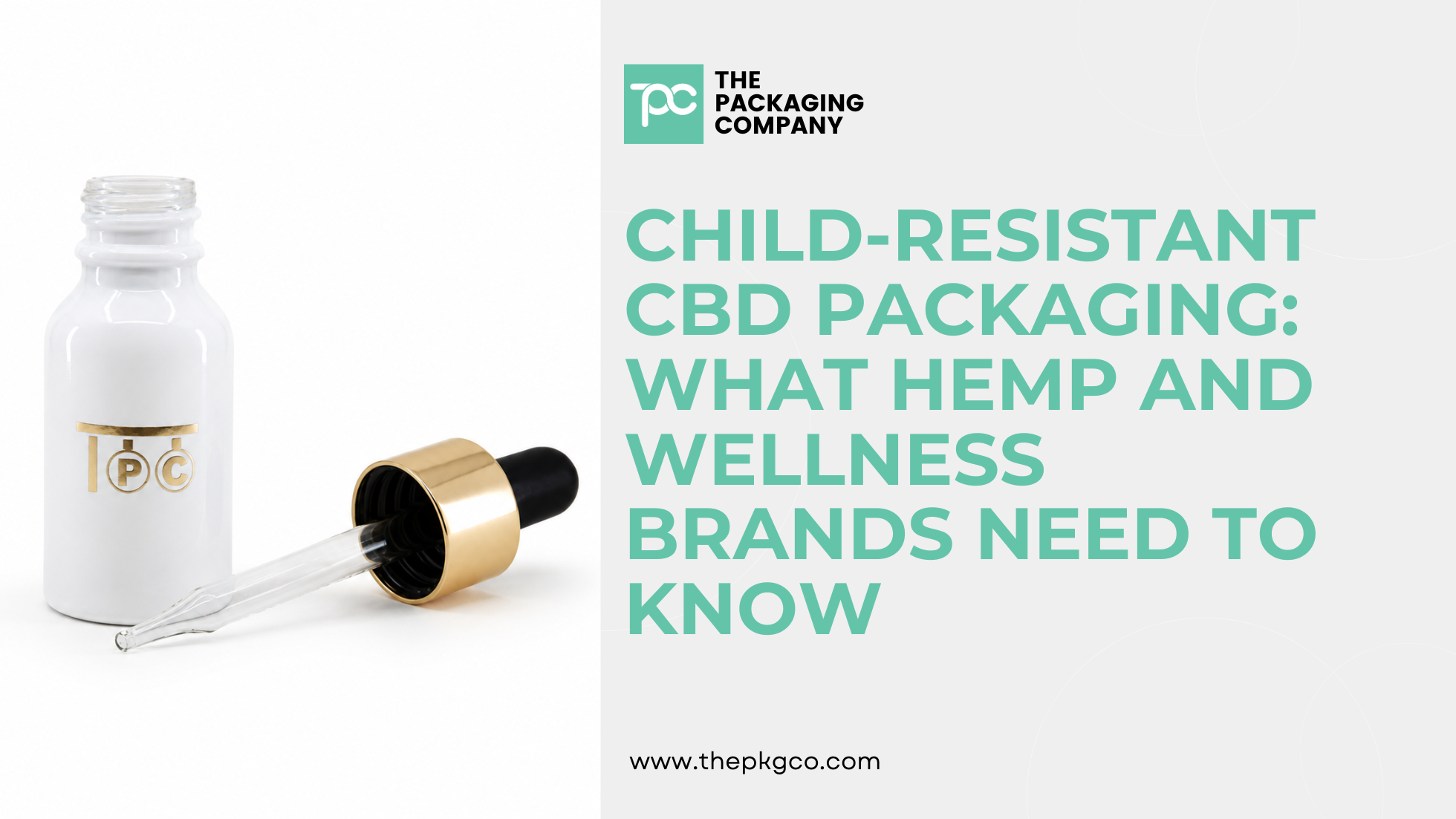
The dominant format for CBD tinctures and sublingual oils. Standard volumes are 15ml, 30ml, and 60ml. Amber glass is the preferred material for formulations where cannabinoid and terpene stability over shelf life is a claim. The CR closure is a push-and-turn dropper cap certified as a system with the specific bottle neck finish.
For brands building a multi-SKU tincture line across different concentrations, the bottle format can remain consistent while the label content varies by SKU. This is a significant operational advantage over formats that require different physical packaging for different concentration levels.
Topicals: CR Squeeze Tubes and Airless Pumps
CBD topicals (creams, balms, salves, and serums) use CR closure mechanisms on squeeze tube or pump formats. CR squeeze tubes use push-and-turn or squeeze-and-turn caps. CR airless pump bottles use directional lock mechanisms on the pump head.
For active-ingredient CBD topicals, including formulations containing cannabidiol at therapeutic concentrations combined with actives like menthol, arnica, or terpene complexes, airless pump formats provide dose precision and formula protection that squeeze tubes don’t. The airless mechanism eliminates air exposure per dispense, preserving active ingredient stability over the product’s use period.
Capsules and Softgels: CR Jars or Bottles
CBD capsule and softgel products use CR jar or bottle formats with push-and-turn or squeeze-and-turn lids. Glass CR jars are the premium standard for high-end capsule products. The visual presentation of the capsules through clear or tinted glass communicates quality. Plastic CR bottles are the standard for high-volume capsule SKUs where per-unit cost is the primary driver.
For iron-containing supplement formulations above the PPPA threshold (250mg elemental iron per unit), CR packaging is a federal mandate regardless of the channel. Confirm whether any formulation components trigger this requirement.
Inhalables: CR Pre-Roll and Vape Formats
CBD hemp pre-rolls and vape products sold through licensed retail require the same CR formats as their cannabis counterparts: CR tubes, tins, or glass jars for pre-rolls; CR cartridge exit bags and compliant vape packaging for vape products. For brands distributing hemp pre-rolls through licensed cannabis retail channels specifically, the full cannabis CR compliance framework applies.
Edibles: CR Bags, Jars, or Tins
CBD edibles sold through licensed cannabis retail require CR packaging meeting the state’s applicable standard. Mylar bags, glass jars, and tins are all used across the CBD edible category. Format selection follows the same logic as for THC edibles. The product type, price point, and state-specific requirements (opaque packaging mandates, individual piece requirements) determine the viable options.
State-Specific CR Requirements for CBD Products
The state-by-state picture for CBD CR packaging is evolving and does not have a clean universal answer. The most current guidance by channel type:
Cannabis retail channel (all states): Full cannabis CR packaging requirements apply. Confirm that the format carries 16 CFR §1700.20 certification for the specific product category, as this is the standard most state cannabis regulations reference by name.
Pharmacy channel: Channel-specific supplier standards apply. Request the retailer’s current standards before finalizing packaging.
California: California’s hemp and CBD regulations have been in development. Confirm current requirements with the DCC and the California Department of Public Health before distribution. California’s cannabis channel uniformly requires 16 CFR §1700.20.
New York: Hemp-derived CBD products sold outside licensed cannabis retail may face requirements under New York’s hemp cannabinoid regulations. Confirm current requirements before distribution.
Colorado, Oregon, Washington: These states have specific hemp product regulations that may include packaging requirements. Confirm current state requirements before entering these markets.
For brands distributing across multiple states, the practical approach is to specify CR packaging certified under 16 CFR §1700.20, the most broadly accepted standard, and maintain the documentation system that supports compliance in whichever channels and states require it. Building a documentation infrastructure around the most stringent applicable standard is always easier than retrofitting compliance after entering a new market.
Documentation Requirements for CBD CR Packaging
The documentation requirements for CBD CR packaging are the same as for cannabis. The third-party laboratory test report confirming the specific format and closure combination passed both panels under the applicable standard is the evidentiary document. A Certificate of Compliance alone is not sufficient in a channel or state that requires CR compliance documentation.
For multi-channel CBD brands where different channels have different documentation expectations, maintaining a packaging compliance register that tracks which certification documentation covers which specific format, and confirming at each reorder that the current production run matches the tested combination, is the system that keeps multi-channel compliance manageable as the brand scales.
For a complete guide to CR documentation practices and how to maintain certification currency across reorders, see our audit-readiness guide.
TPC’s CR Packaging for CBD and Hemp Brands
TPC’s child-resistant packaging line covers the full range of formats relevant to CBD and hemp brand applications: the Child-Resistant Glass Dropper Bottle for tinctures and oils, CR squeeze tubes and airless pump formats for topicals, CR jars for capsule and edible products, CR bags for edible and bulk formats, and CR tins for pre-roll and premium edible applications.
All formats carry 16 CFR §1700.20 certification documentation. MOQ starts at 5,000 units and varies by format. Dropper bottles, squeeze tubes, and glass-format products typically start at 10,000 units. Pre-production samples are standard before any bulk commitment.
For brands evaluating CR packaging across multiple formats and channels, our child-resistant packaging solutions guide is the complete reference. To discuss your specific product, channel, and compliance requirements, contact our team.
Frequently Asked Questions
Is CR packaging required for CBD products? It depends on the channel and state. CBD products sold through licensed cannabis retail channels are typically subject to the same CR requirements as THC cannabis products in that state. Pharmacy channel placement often requires CR packaging under retailer supplier standards. General retail and direct-to-consumer channels generally do not mandate CR packaging for hemp-derived CBD products, though some states have specific requirements. Confirm the requirements for each channel and state before finalizing packaging.
What CR packaging format is most common for CBD tinctures? CR amber glass dropper bottles with push-and-turn caps are the most common format for CBD tinctures across both cannabis retail and pharmacy channels. The 30ml volume is the standard retail size. Amber glass provides light protection for cannabinoid and terpene stability. The push-and-turn CR dropper cap is certified as a system with the specific bottle neck finish.
Can I use the same packaging for cannabis retail and general retail CBD products? Yes, if the packaging is CR certified under 16 CFR §1700.20 and meets any state-specific requirements for both channels. Using a single compliant format across all channels avoids a repackaging event when entering a new channel with CR requirements. Brands building multi-channel distribution typically default to the most stringent applicable standard across all channels.
What documentation do I need for CBD CR packaging compliance? The third-party laboratory test report confirming the specific bottle and closure combination passed both the child panel (85% threshold) and adult panel (90% threshold) under 16 CFR §1700.20. A Certificate of Compliance without an underlying test report is not sufficient for channel or state compliance requirements that specify CR documentation. Maintain reorder confirmations at each production run confirming the current order matches the tested combination.
Does CR packaging affect the retail price positioning of CBD products? The per-unit cost of CR packaging is higher than non-CR alternatives, but the difference is modest relative to typical CBD product retail price points, typically $0.15–$0.50 per unit depending on format and volume. For brands at $25+ retail, this cost is easily absorbed. For high-volume value-tier products, it’s a planning variable but not a prohibitive one. The channel access that CR packaging enables (cannabis retail, pharmacy) typically more than offsets the packaging cost premium.
What is the difference between ASTM and 16 CFR §1700.20 for CBD packaging? 16 CFR §1700.20 is the primary federal CR standard under the Poison Prevention Packaging Act. It covers both reclosable and non-reclosable formats and is the standard referenced in most state cannabis regulations and pharmacy supplier standards. ASTM (F1272 for reclosable tins and jars, F1702 for tubes) is a supporting test method used to verify compliance with the CFR standard, not an alternative certification. For CBD brands distributing across multiple channels and states, confirming 16 CFR §1700.20 certification is the right baseline.