



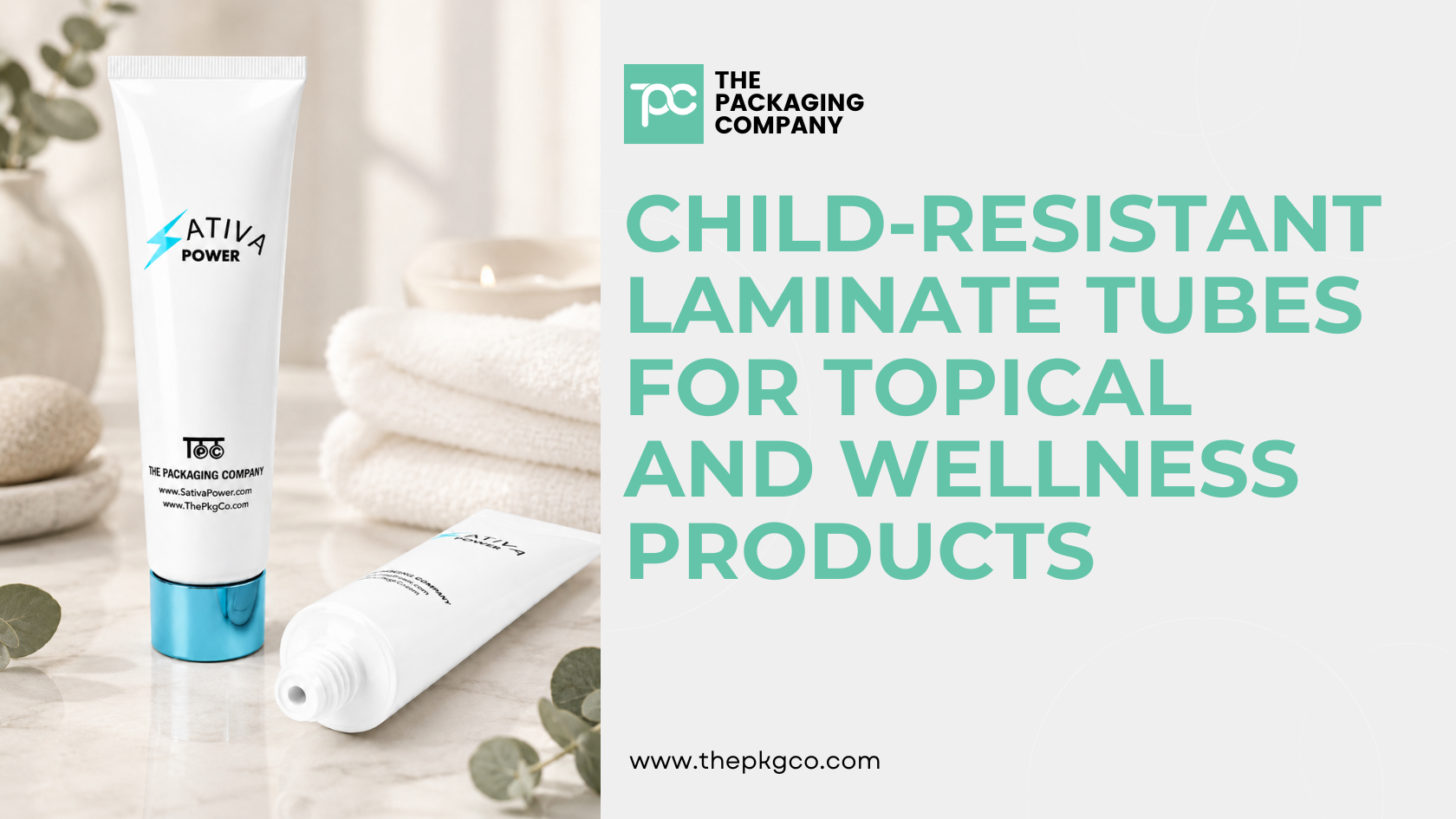
Laminate tubes are the workhorse format of topical and wellness packaging. They’re flexible, they dispense cleanly across a wide viscosity range, they support high-quality decoration on a curved surface, and they’re familiar to consumers across every product category from skincare to pharmaceuticals. Adding child-resistant compliance to that format introduces a layer of engineering and planning that standard cosmetic tube sourcing doesn’t require — but that regulated-market brands navigating cannabis topicals, CBD wellness products, and pharmaceutical-adjacent formulations need to get right before production.
This guide covers how TPC’s CR Squeeze Tube is built and why the construction matters for regulated topicals, how the CR closure mechanism works, what artwork layout requires on a cylindrical surface, and what to confirm on MOQ and reorder before committing to production.
What Makes a Laminate Tube “Child Resistant”
The term child resistant applies to the closure mechanism, not to the tube body. A laminate tube is made from layers of film bonded together — the construction determines barrier performance. The CR certification comes from the cap.
CR closures on laminate tubes work through one of two primary mechanisms:
Push-and-turn (CRC) cap — the most common CR closure for laminate tubes. The cap pushes down and turns counterclockwise to open. The downward pressure engages the CR mechanism before the rotation releases the cap. This requires a two-step action that young children cannot reliably execute, while remaining intuitive for adults after the first use.
Squeeze-and-turn cap — simultaneous lateral compression and rotation. Provides stronger resistance than standard push-and-turn and is used where the product or market requires additional resistance margin.
Both are certified under ASTM when the specific tube and cap combination has passed third-party panel testing. The cap and tube body are tested as a system — the certification applies to the combination as manufactured, not to the cap or tube independently. When sourcing CR laminate tubes, always request the test report for the specific cap-and-tube combination being ordered, not just a general CR cap certification.
How TPC’s CR Squeeze Tube Is Built
The construction of TPC’s CR Squeeze Tube is the decision that determines how well the packaging protects the formulation inside it. The tube is available in three barrier configurations depending on what the formulation requires.
Laminated Aluminum Barrier (3-Layer or 5-Layer)
The aluminum barrier configurations use a laminated aluminum/LDPE construction — an aluminum foil barrier layer bonded with a low-density polyethylene inner layer and an outer print surface. This creates a true hermetic barrier against oxygen, moisture, and UV light that standard plastic tubes cannot achieve.
Standard plastic tubes breathe — oxygen and moisture permeate through the tube wall over time, degrading sensitive ingredients. The laminated aluminum barrier eliminates that permeability entirely, preserving formula integrity from fill date through last use. This is the right construction for cannabis topicals, CBD formulations, and any active-ingredient wellness product where oxidation is a real shelf-life risk.
3-layer is the standard specification for most cannabis topicals, CBD creams, and active-ingredient wellness formulations. It provides strong barrier performance at a practical cost and lead time.
5-layer is the specification for highly sensitive formulations — high-terpene cannabis topicals, retinoids, vitamin C serums, and products where oxidation directly affects efficacy and shelf life. Maximum barrier, appropriate for brands where product stability is a primary quality or marketing claim.
The trade-off of aluminum barrier constructions is end-of-life recyclability. The bonded dissimilar materials cannot be separated in standard single-stream recycling infrastructure. For brands with sustainability positioning, weigh this against the barrier performance benefit before specifying.
All-Plastic Construction
For brands where sustainability credentials matter to retail buyers or consumers, the CR Squeeze Tube is also available in an all-plastic construction without the aluminum barrier layer. Barrier performance is lower — appropriate for formulations that don’t require significant oxygen or moisture protection, such as standard moisturizers, basic balm formulations, or products without active ingredients sensitive to environmental exposure. Not the right construction for terpene-rich cannabis topicals or oxidation-sensitive actives.
The all-plastic option supports a cleaner recyclability story and is the right call when the formulation doesn’t require aluminum-level barrier performance.
The CR Cap and What It Communicates
The cap on TPC’s CR Squeeze Tube uses a push-and-turn CRC mechanism — the cap pushes down and turns counterclockwise to open. This two-step action requires simultaneous downward pressure and rotation, which young children cannot reliably coordinate, while becoming intuitive for adults quickly.
The cap is a design element as well as a compliance element. Custom color is available on the cap body to match or contrast the tube — a matched cap creates a unified, premium presentation; a contrasting cap creates a deliberate visual signal that can serve as a brand detail or a functional indicator. Matte and gloss finish options are available on the tube surface, and the cap communicates quality through its weight and the consistent resistance of the CR mechanism.
The CR mechanism doesn’t limit what the cap looks like — it determines how it opens. Everything else about the cap presentation is customizable within that constraint.
Artwork Layout on CR Laminate Tubes
The cylindrical surface of a laminate tube is a more constrained print environment than a flat substrate, and the CR cap adds specific constraints that affect how much usable print area is available and how the design has to be structured.
The back seam. Laminate tubes have a longitudinal seam where the film is joined. This seam is not a printable surface and should not have design elements placed across it. The seam width is typically 5–7mm depending on tube diameter. The dieline provided by the supplier will show the seam zone — design elements should be kept clear of it.
The cap overhang zone. The area of the tube body immediately below the shoulder — where the cap sits when closed — is partially obscured by the cap when the product is on shelf. For compliance text that must be visible at point of sale, confirm it sits below this zone with appropriate clearance.
The crimp or base seal. The bottom of the tube is crimped or heat-sealed after filling. This area carries only the lot code, manufacturing date, or other variable data applied post-fill. Brand elements should not be placed in the base area.
The available print surface is the tube circumference minus the seam width, running from the base of the cap overhang zone to the top of the crimp. TPC’s CR Squeeze Tube at 30mm diameter provides approximately 94mm of usable circumference — a meaningful surface with more constraints than a flat substrate.
Compliance text requirements for regulated products — THC or CBD content, warning language, producer information, universal symbol, track-and-trace — can consume a significant portion of the available surface for cannabis topicals. Map the required compliance text to the actual tube dimensions and dieline before finalizing artwork. Running out of space for mandatory content after the design is approved is an expensive revision.
TPC’s CR Squeeze Tube supports silk-screen printing across all three sizes (30ml, 60ml, 90ml), with custom color on tube body, shoulder, and CR cap. Pre-production sampling and decoration approval are standard before any full production run.
MOQ and Reorder Planning for CR Laminate Tubes
CR laminate tubes are produced in minimum order quantities that reflect the tube manufacturing and decoration setup costs. Understanding the MOQ structure and building reorder planning around it prevents the two most common operational problems with tube programs: running out of packaging mid-production and inconsistent decoration quality across reorder batches.
MOQ at TPC for the CR Squeeze Tube is 10,000 units per size. Multiple sizes (30ml, 60ml, 90ml) can be run within a single program. Confirm MOQ for your specific tube specification and layer count during the quoting process.
Decoration consistency across reorders is a quality consideration that brands running high-volume tube programs manage actively. For brands with exact color standards, specifying a color target (Pantone or CIE Lab values) and requesting color confirmation on the first carton of each reorder batch is the practice that maintains consistency across multiple production runs.
Reorder lead time for CR laminate tubes runs 6–8 weeks from order to delivery for standard decorated configurations. For brands with predictable consumption rates, setting a reorder trigger at 8–10 weeks of remaining inventory ensures continuous production supply.
Documentation at reorder. Each reorder is a documentation event — a moment to confirm with your supplier that the current production run matches the tested and certified CR cap-and-tube combination on file. Written confirmation at each reorder maintains the documentation currency that regulated market compliance requires. For a full breakdown of how to build this system, see our CR packaging audit-readiness guide.
TPC’s CR Topical Packaging Line
TPC’s child-resistant topical packaging line includes the CR Squeeze Tube — available in 30ml, 60ml, and 90ml, with 3-layer or 5-layer aluminum laminate barrier or all-plastic construction, ASTM F1702 certified, MOQ 10,000 units per size — alongside CR airless pump bottles across multiple volume configurations and CR dispenser formats for cannabis topicals, CBD creams, medicated lotions, and regulated wellness products.
For the full CR packaging format overview across tins, tubes, jars, bags, and topical formats, see our child-resistant packaging solutions guide.
For brands evaluating CR tube formats across pre-roll and topical applications, our CR tubes guide covers the full tube landscape. To discuss your specific formulation, format, and compliance requirements, contact our team.
Frequently Asked Questions
What is a child-resistant laminate tube? A child-resistant laminate tube is a multi-layer flexible tube combined with a CR-certified closure mechanism — typically a push-and-turn or squeeze-and-turn cap — that has passed third-party panel testing under ASTM. The CR certification applies to the cap-and-tube combination as tested, not to the tube construction independently. Laminate tubes are widely used for regulated cannabis topicals, CBD wellness products, and pharmaceutical-adjacent formulations.
Which barrier configuration is best for cannabis topicals? TPC’s CR Squeeze Tube is available in 3-layer aluminum laminate, 5-layer aluminum laminate, or all-plastic construction. For most cannabis topical formulations, 3-layer provides adequate barrier protection against oxygen, moisture, and UV degradation. For high-terpene formulations, retinoids, or vitamin C serums where oxidation directly affects efficacy and shelf life, 5-layer is the appropriate specification. All-plastic construction is available for brands with sustainability requirements where the formulation doesn’t require aluminum-level barrier performance.
What certification standard applies to TPC’s CR Squeeze Tube? TPC’s CR Squeeze Tube is certified to ASTM F1702 — the standard specifically developed for reclosable packaging. This meets federal CR requirements accepted by cannabis regulators in most licensed US markets. Always confirm your specific state’s packaging requirements, as some states may specify 16 CFR §1700.20 by name. Consult your compliance team before finalizing packaging for any new state market.
How much of the tube surface is available for artwork? The printable surface is the tube circumference minus the seam width (typically 5–7mm), running from below the cap overhang zone to above the crimp or base seal. TPC’s CR Squeeze Tube supports silk-screen printing with custom color on the tube body, shoulder, and cap. For regulated products with mandatory compliance text requirements, map the required content to the actual tube dimensions and dieline before finalizing design.
What MOQ applies to CR laminate tubes at TPC? MOQ for TPC’s CR Squeeze Tube is 10,000 units per size (30ml, 60ml, 90ml). Multiple sizes can be run within a single program. Pre-production samples are standard before any bulk commitment. Contact TPC for current lead time for your specific barrier configuration and decoration specification.
How do I maintain decoration consistency across CR tube reorders? Specify a color target (Pantone or CIE Lab values) rather than relying on visual matching from a previous batch. Request color confirmation on the first carton of each reorder batch before the full shipment releases. This is the standard quality control practice for tube programs where brand color consistency across production runs is a requirement.